Ask five guys what a burst fade is and you'll get five different answers. The taper, the drop fade, and the burst fade get mixed up constantly — and that's how people end up asking for one cut and walking out with another. They're all clean. They're all in the fade family. But they sit on your head in completely different ways.
Here's the breakdown, the way it gets explained in the chair at Studio K in Guelph — so next time you book, you know exactly what you're ordering.
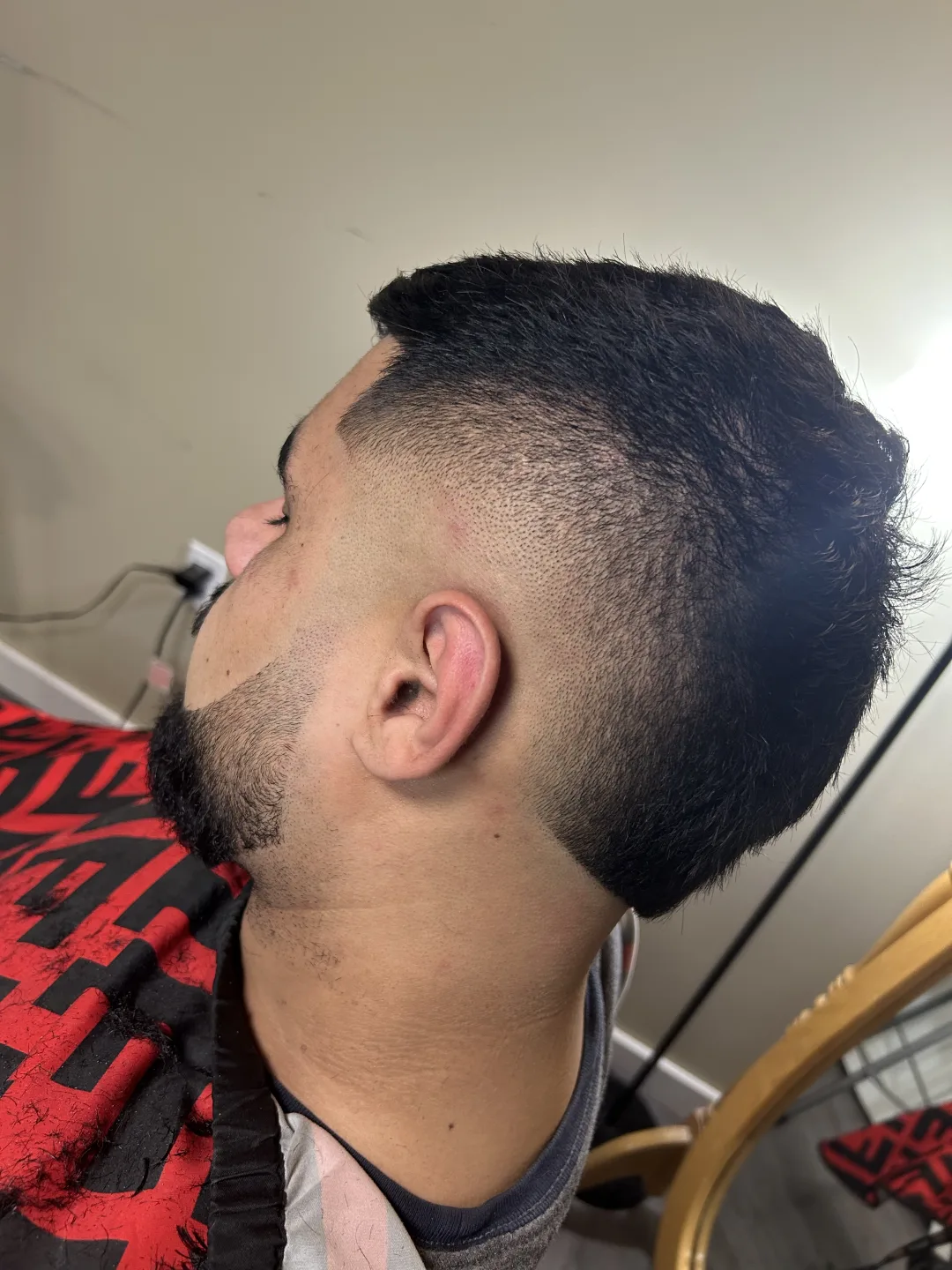
What is a taper?
The taper is the most understated of the three. The hair shortens gradually in just two zones — around the sideburns and at the neckline — while the rest of the sides hold their length. No big gradient wrapping the whole head. Just tight, tidy edges where hair meets skin.
Because so little of the head is faded, a taper reads as polished rather than flashy. It's the office-safe option, it flatters longer styles, and it grows out more gracefully than any full fade. A low taper under a textured crop is one of the most requested combinations going right now, and for good reason — it looks clean without trying hard.
Ask for it by naming the zones: “low taper on the sideburns and neck, keep the length everywhere else.”
What is a drop fade?
A drop fade is a full fade with a curveball — literally. Instead of running in a straight band around your head, the fade line drops behind the ear, following the natural curve of your skull down toward the nape of the neck.
That arc does two things. It hugs the shape of your head, which makes the whole cut look tailored rather than stamped on. And it keeps more weight at the crown, so rounded styles up top — curls, waves, textured crops — look fuller and better balanced.
If the back of your head has a strong curve, a drop fade will usually flatter it more than a straight fade line. It's the kind of detail most people can't name but everyone notices.
What is a burst fade?
The burst fade is the boldest of the three. The fade radiates around the ear in a semicircle — like a sunburst — while the neckline stays full. Skin behind the ear, length at the back. That combination is what makes it instantly recognizable.
It's the engine behind the modern mullet, the mohawk, and every variation in between, because it cleans up the sides without touching the back. Wearing a burst fade says you made a decision. Nobody stumbles into one by accident.
It also frames the face beautifully from the side, which is why it photographs so well — the arc around the ear gives the whole cut a sculpted, deliberate shape.
Already sold? Skip ahead and book the chair →
So which one should you choose?
Match the cut to the life:
- Choose a taper if you want low-key sharp, work somewhere conservative, or wear your hair longer on top and just want the edges handled.
- Choose a drop fade if you want a full fade that follows your head shape and keeps some fullness at the crown — the tailored middle ground.
- Choose a burst fade if you're keeping length in the back, wearing a mohawk or a modern mullet, or you just want the cut to carry some attitude.
One more thing worth knowing: any of the three can be taken all the way down to bare skin at its shortest point. That's the skin finish, and if you want the full picture on it, read our skin fade guide.
Does a beard change the pick?
If you wear a beard, factor it in before you decide. A burst fade flows straight into a beard — the arc around the ear connects to the beard line for one continuous, sculpted shape, which is why the combo is everywhere. A taper gives the most natural hand-off, gently stepping the sideburn down into the beard with no hard transitions. A drop fade works too, but because the fade falls behind the ear, the blend into the beard has to be managed a little more deliberately.
Whichever you choose, the fade and the beard should be cut as one piece, not two separate jobs. We broke down exactly how that works in blending your beard into your fade.
How do you ask for each one in the chair?
Keep it simple and name three things: the style, the height, and what stays.
- “Low taper — just clean up the sideburns and the neck.”
- “Mid drop fade, let it fall behind the ears, texture on top.”
- “Burst fade around the ears, keep the back.”
A photo settles any doubt in two seconds — barbers think in pictures. And whichever one you land on, finish it with a crisp lineup so the whole cut frames your face properly.
Still torn? That's what the consult at the start of every appointment is for. Book the chair, describe the vibe, and let your barber match the fade to your head — not the other way around.